
Climate — Designing With the Mediterranean Climate
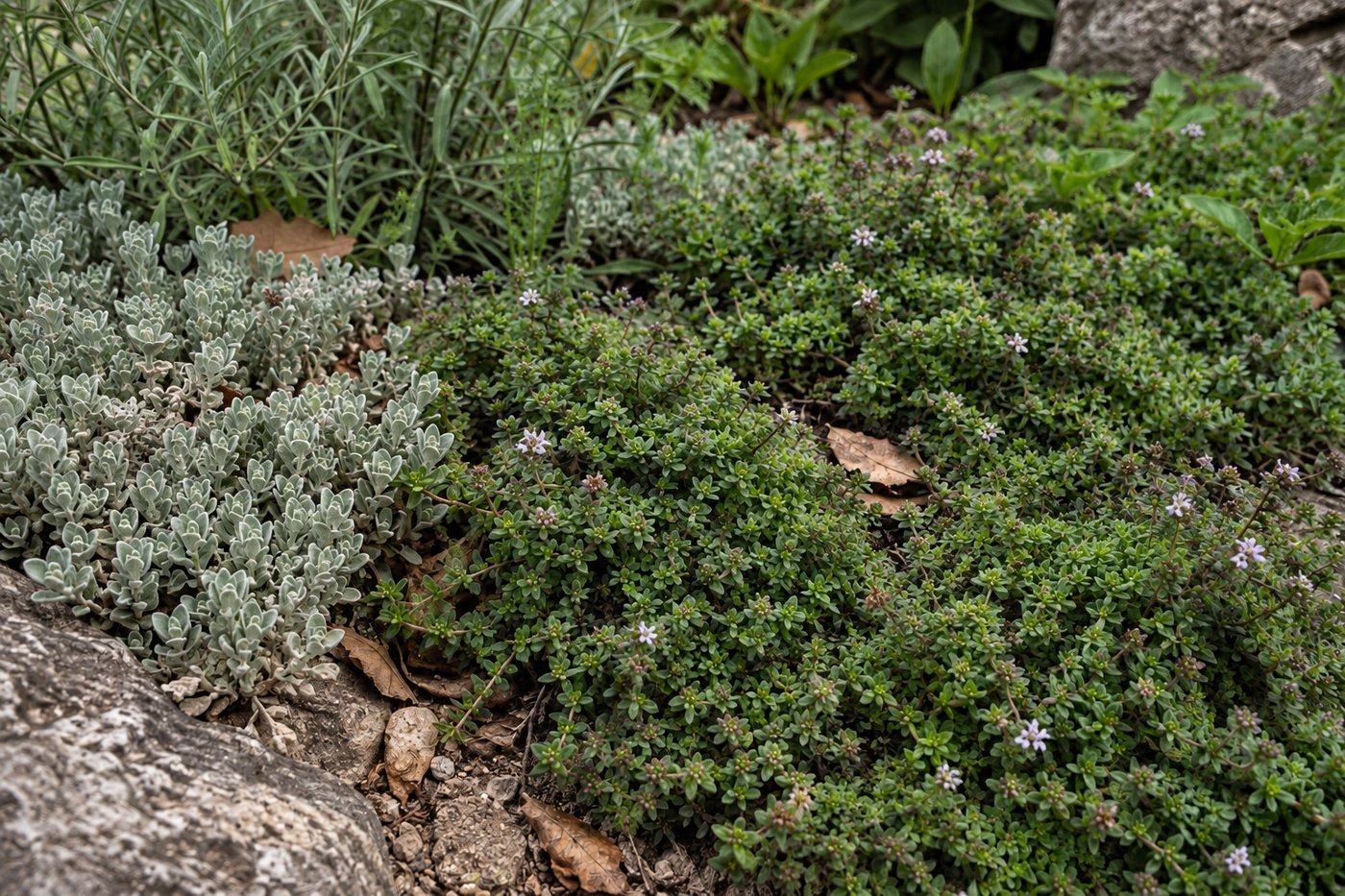
Don’t start by choosing beautiful plants. Start by understanding where they will live.
“The right plant in the right place” sounds simple, but it is one of the most important principles behind the way I approach garden design.
A plant that repeatedly dies, a border that constantly needs replanting, a garden that requires continuous summer irrigation, or foliage damaged by wind year after year do not necessarily mean that the garden is poorly maintained.
Sometimes the problem began much earlier:
the plant was placed somewhere that never really suited it.
So before choosing plants, colours or flowering combinations, I prefer to ask a different question:
What kind of place is this, really?
01|There are different climates within the same garden
We often describe an area as having a Mediterranean climate, but for plants this is still far too broad.
Within a single garden, two places only a few metres apart can provide completely different growing conditions.
A south-facing wall stores and releases heat.
The sheltered side of a building may create protection from strong winds.
Under a tree canopy there is less light, but also greater competition from roots.
A coastal garden may be exposed to strong winds and salt spray.
On sloping land, aspect, drainage and cold-air movement create further differences.
This is why site analysis goes beyond asking how cold the winter becomes.
I also look at:
Together, these conditions create the garden’s microclimates.
And good planting design begins with understanding those differences.
02|Stop changing the environment to support the wrong plant
When a plant struggles, we often try to compensate through maintenance:
more irrigation,
more shade,
more fertiliser,
repeated pruning of damaged growth,
or simply replacing the plant when it dies.
These measures may work temporarily.
But when the site conditions fundamentally conflict with what the plant needs, we are simply using more resources to keep it alive somewhere it does not naturally want to be.
My approach is closer to this:
That does not mean choosing only the toughest species.
It means understanding how different plants grow and survive, and then deciding where each one is most likely to thrive.
This principle is especially important in Mediterranean gardens, drought-tolerant gardens and coastal landscapes, where heat, sun, wind and water availability strongly influence plant performance.
03|The shape of a plant tells us how it has learned to survive
Plants do not simply endure climate passively.
Many characteristics we find beautiful are actually the result of adaptation.
Plants growing in exposed, dry environments are often lower and more compact.
Grey or silver foliage, hairs and waxy surfaces can help reduce water loss and cope with intense sunlight.
Some species use the shade of rocks, buildings or tree canopies to avoid the most intense heat.
Others concentrate their growth and flowering during the most favourable part of the year before slowing down or becoming dormant.
In highly exposed mountain environments, compact cushion-shaped and rounded plants are common.
To me, these forms are not only aesthetic.
They are information.
The plant is telling us:
The role of design is not to impose a predetermined appearance on vegetation, but to read these relationships and work with them.
04|Turn microclimates into different planting zones
Once the site has been understood, the next step is not to find one plant palette that can be repeated across the entire garden.
Quite the opposite.
I prefer to see a garden as a small landscape made up of several different environments.
Hot, dry and exposed areas
These can support plant communities adapted to intense sun, wind and limited water.
Coastal and wind-exposed areas
Salt tolerance, wind resistance and structural stability become key considerations.
Areas shaded by trees or buildings
Plants must cope not only with reduced light, but also root competition and different soil moisture conditions.
Areas with different drainage conditions
These require different species, planting densities and ground-cover strategies.
A garden therefore does not need the same plants, density or even colour palette everywhere.
The differences within the site can become part of the design itself.
05|Good planting design is not a plant list
This is why a list of drought-tolerant plants is not enough to create a truly resilient garden.
The same species may behave very differently depending on where it is planted.
What matters more is the relationship between three things:
Site conditions → plant requirements → plant community
When these three elements are well matched, plants have a much better chance of establishing stable and lasting communities.
And when vegetation is no longer living under constant stress, the garden can also require fewer unnecessary interventions:
A genuinely low-maintenance garden does not begin with doing less.
It begins with making better design decisions.
06|Resilience does not mean a garden that can survive everything
For me, resilience does not mean finding indestructible plants.
Nor does it mean creating a garden that requires no care.
True resilience is closer to a good match:
plants can live with the conditions already present on the site, and we do not need to continually alter the environment to keep them alive.
That is why Climate is not simply a technical box to tick during the design process.
It is where the design begins.
Before deciding which plants to use, which colours to introduce or what the garden should ultimately look like, I want to understand:
how sunlight moves across the site,
how wind passes through it,
where water collects,
where summer heat becomes most intense,
where winter conditions are colder,
and, above all:
What does this place genuinely allow to grow?
Only then does the design begin.