
Learning from Nature — From the Cracks of Genoa’s Walls to a Living Garden
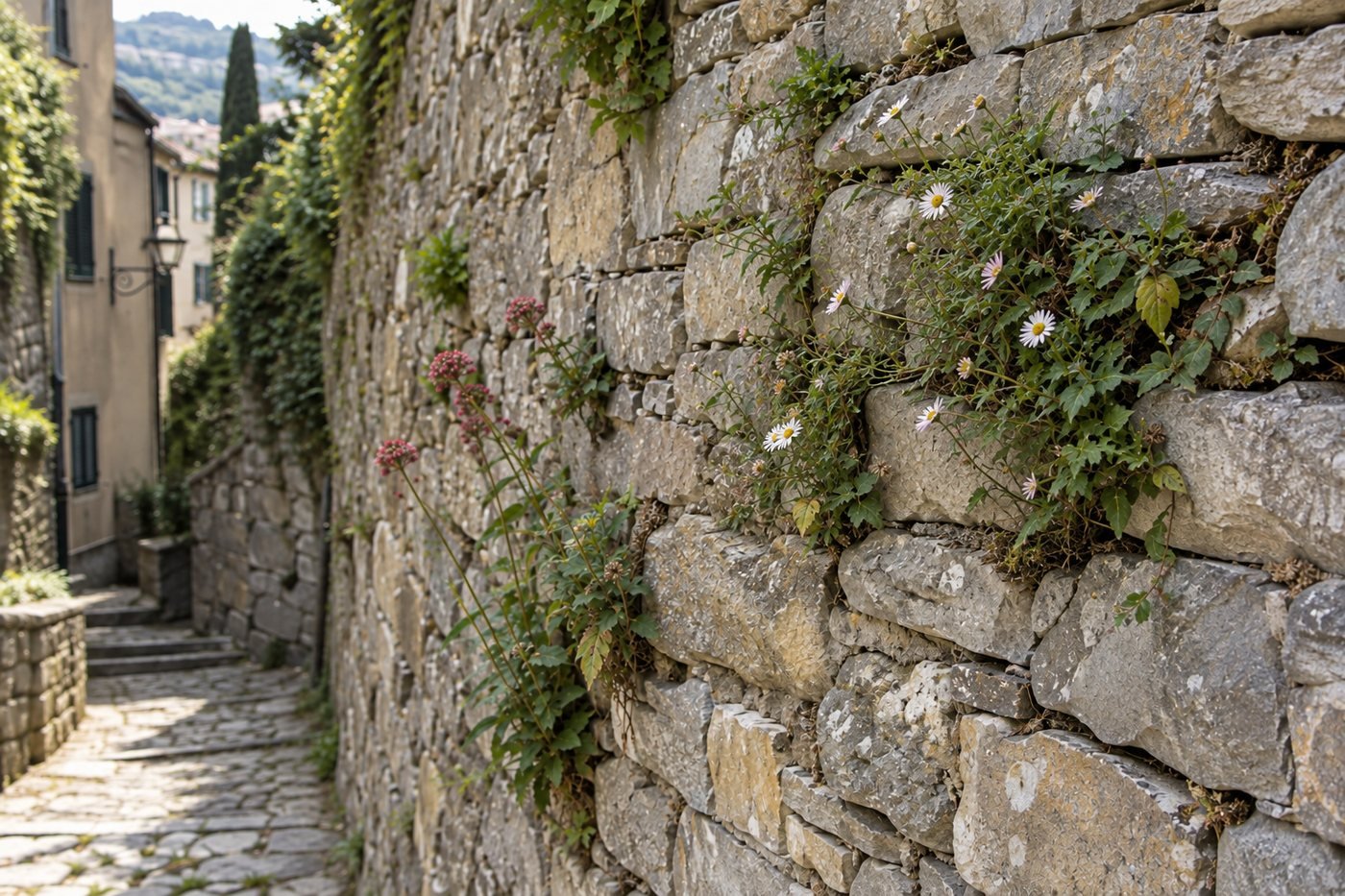
Observe how plants live before designing how they should live together
Along the paths and dry-stone walls of Genoa, Erigeron and red valerian flower from narrow cracks.
Fig trees establish themselves in forgotten corners.
At the edges of fields, poppies appear when the season is right, complete their life cycle and leave behind seeds for the next generation.
These plants receive very little care, yet they still find opportunities to survive where soil, water and space are limited.
They continually make me ask:
For me, learning from nature does not mean recreating wilderness.
It means understanding how plants occupy space, renew themselves, compete, coexist and evolve, and translating those dynamics into planting design.
01|Look at how a plant lives, not only how it flowers
When choosing plants for a garden, it is easy to focus first on colour, form and flowering season.
But what determines how a garden will look in three, five or ten years also includes:
Some plants remain in roughly the same place for years, gradually forming larger and more mature clumps.
Others spread through runners, rhizomes or underground growth.
Some individual plants are relatively short-lived, yet persist as a population through self-seeding.
Piet Oudolf’s planting work encouraged me to look beyond the moment of flowering and consider the whole life cycle of a plant and its long-term behaviour within a community.
Olivier Filippi’s research into Mediterranean plants and dry gardens led me to look more closely at how plants respond to drought, poor soil and exposure, and how beauty can emerge from those adaptations.
These perspectives have also changed the way I observe spontaneous urban vegetation.
02|Different plants use different survival strategies
Some plants survive through renewal
Poppies growing along field edges reveal the potential of seed.
The individual plant may disappear, but the population continues when a new generation emerges under favourable conditions.
In a garden, this means that some landscape effects can persist through generational renewal rather than relying on every single plant remaining in place for many years.
Some plants survive by occupying space
Certain species gradually spread until they create a continuous ground layer.
This can reduce bare soil and limit opportunities for some weeds to establish.
But spreading ability also means competition.
A highly vigorous species can reduce the space available to neighbouring plants.
Others are adapted to periods of scarcity
Succulent tissues can store water.
Small leaves, slow growth and seasonal dormancy can help plants survive periods of drought or limited resources.
Understanding these rhythms also helps us accept that a Mediterranean garden does not need to look identical throughout the year.
Seasonal change can be part of its character.
03|Learning from nature does not mean using everything that grows spontaneously
Spontaneous vegetation can teach us a great deal.
But vigour alone does not make a plant suitable for a garden.
Tree of heaven is a clear example.
Its ability to spread and regenerate is fascinating to observe, but that does not mean it belongs in a planting scheme that needs to remain manageable over time.
Learning from nature therefore also means:
observing, understanding, selecting and deciding.
Design does not disappear.
The nature of control simply changes: instead of trying to keep every plant permanently fixed in place, we guide vegetation dynamics within a clear spatial structure.
04|Turn survival strategies into design tools
These observations become useful when they return to real garden problems.
If a site is continually full of weeds
Rather than thinking only about repeated weeding, I first ask why the soil remains exposed.
Could plants suited to the site gradually create a denser ground-cover system?
A well-established plant layer can reduce opportunities for some weeds to colonise bare soil.
During the establishment phase, however, timely weeding remains essential to help the desired planting community develop.
If we want to reduce repeated replanting
Long-lived plants suited to the site can provide the structural framework, while seasonal flowers and a controlled amount of self-seeding plants introduce renewal.
The garden retains a recognizable structure while still allowing small changes from year to year.
If the site is dry, poor or windy
I do not treat these constraints as one generic “difficult condition”.
Drought, poor soil and wind each require different strategies.
Reducing irrigation starts with matching plants to the site and creating suitable conditions for strong root establishment.
If we want the garden to evolve
We can allow space for self-seeding and spreading while keeping paths, edges and key structural elements clear.
Deciding which seedlings to keep, which plants to thin and which groups to contain becomes part of an ongoing design process.
05|Planting design becomes the design of a community
Good planting design is not only about deciding where each plant begins.
It also considers what happens afterwards.
I therefore look at:
Seen this way, the garden is no longer a collection of independent botanical objects.
It becomes a plant community.
The more we understand these relationships, the more garden care can move away from constant correction and towards observation, selection and guidance.
06|A low-maintenance garden is not an abandoned garden
Allowing vegetation to evolve does not mean leaving the garden completely alone.
In fact, the establishment period often requires careful intervention:
As the plant community becomes established, maintenance can gradually shift from repeated replacement and correction towards more selective management.
That distinction matters.
07|Designing a living ground layer
I like to think of the garden surface as a space that plants can occupy, share and redistribute over time.
At the beginning, we decide where plants are placed.
But we also design with the future in mind:
how they will grow,
meet,
spread,
retreat,
and regenerate.
Clear paths, edges, structural planting and seasonal composition allow these changes to remain legible and enjoyable.
This is what I mean by a living garden:
a garden adapted to local conditions,
with its own rhythm of growth,
capable of changing over time,
while still retaining spatial clarity and design intent.