
The Mediterranean Mosaic — Rethinking the Ground Plane of the Garden
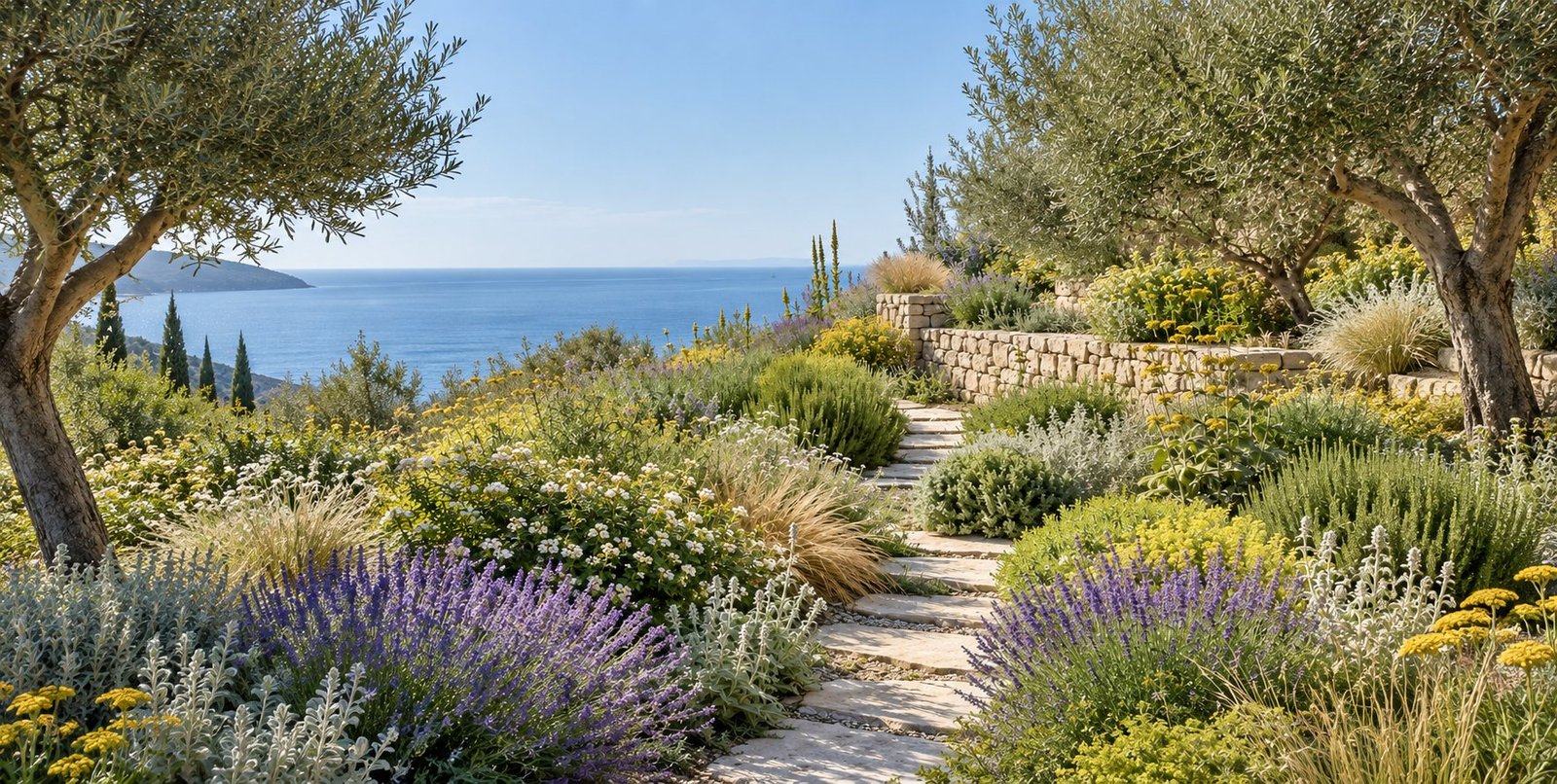
A Mediterranean garden does not need to stay green all year to be beautiful
When I look at Mediterranean landscapes, what strikes me most is not the amount of green.
It is the balance between different colours, textures and materials.
White limestone, red soil, dark evergreen shrubs, silver-grey aromatic plants, the bright yellow of harvested fields and dense holm oak woodland come together to create a landscape that is rich without necessarily feeling chaotic.
This landscape does not rely on one colour to create order.
Quite the opposite.
Its beauty comes from difference.
And that raises a question:
In many private gardens, lawn still acts as the default background.
A continuous, tidy and permanently green surface is often associated with the idea of a garden being complete.
For me, this deserves to be reconsidered.
01|From the Mediterranean mosaic to a new understanding of the ground plane
The rich colour palette of Mediterranean landscapes can become part of garden design.
And it does not come only from plants.
It also comes from the relationship between:
Olivier Filippi’s research into drought-tolerant Mediterranean plants and lawn alternatives has helped make this question much more systematic.
Replacing lawn is not simply about finding a greener plant that uses less water.
It means rethinking the ground plane itself.
Different areas can use different combinations of plants and materials according to:
The ground stops being a neutral surface that needs to be filled.
It becomes part of the design.
02|Seasonal change is not a flaw
This richness does not exist only across space.
It also exists through time.
One idea I increasingly believe in is:
In spring, Alliums emerge from the ground and suddenly create vivid spheres of colour.
In summer, Sarcopoterium may reveal its dry, thorny brown structure.
After the first autumn rains, short-lived bulbs can suddenly break through the severe tones of a dry meadow.
Zoysia may form a yellow carpet in winter.
These are not necessarily signs that the garden is in poor condition.
They are traces of the season.
If a garden needs constant heavy irrigation, frequent mowing and continuous intervention simply to maintain the same green appearance all year, it may not be expressing the Mediterranean climate at all.
It may be resisting it.
03|A garden can contain many colours without losing order
One reason lawns are used so widely is that they create an immediate sense of order.
One continuous surface.
One colour.
An image that is easy to read.
But order does not have to come from uniformity.
It can also come from:
clear paths,
repetition of materials,
strong planting structure,
and a deliberate relationship between open and planted space.
White gravel, silver foliage, dark green shrubs, golden dry grasses and exposed soil can all coexist within the same composition.
Richness does not mean disorder.
The role of design is to give structure to difference.
04|Different ground surfaces for different ways of living
In my work, I therefore do not begin by asking:
I prefer to ask:
Lawn, ground-cover plants, gravel, paths, stone and terraces are all tools within the same ground system.
There is no single correct solution for every garden.
What matters is creating a coherent relationship between use, climate, maintenance and place.
I am more interested in surfaces with rhythm, layering and seasonal change than in repeating one uniform surface everywhere.
05|Less lawn does not mean less garden
Reducing lawn does not necessarily make a garden poorer.
Often, it can do the opposite.
A ground plane composed of ground covers, low shrubs, grasses, gravel and stone can offer:
The real question is not:
It is:
06|Let the garden feel as if it grew from the land
What I am looking for is not the imposition of a predetermined form onto the site.
I prefer to begin with:
climate · soil · light · wind · vegetation · use
and allow the design to emerge from those conditions.
Stone, gravel, ground covers, shrubs, grasses and seasonal change can come together to create a landscape that preserves the colours, textures and rhythm of the place.
Such a garden does not need to look the same all year.
It can become drier in summer.
Reveal more structure in winter.
And begin growing again after the first autumn rains.
For me, a garden with a genuine sense of place is not simply a garden made “in Mediterranean style”.
It is a garden that makes you think:
07|How this becomes a design service
In a real project, this approach translates into specific decisions:
The result is not a copy of nature.
It is a designed landscape that uses the logic of the place to build its own identity.
Would you like your garden to feel as though it belongs to its setting, rather than like a standard garden that could exist anywhere?