
Care — How Can We Reduce Garden Maintenance?
Maintenance should not be an issue considered only after the garden is built.
When people talk about a low-maintenance garden, it is easy to think simply of less pruning, less watering and less work.
For me, however, Care is not just about reducing maintenance.
It is about deciding, during the design process, which maintenance is genuinely necessary in the first place.
Much of the future workload is already determined before the garden is built.
A large lawn that requires frequent mowing and irrigation, plants poorly suited to the local climate or an unnecessarily complex planting scheme can all generate years of additional work.
So instead of asking only:
I prefer to ask:
01|First, remove maintenance that does not need to exist
The lawn is a clear example.
In many private gardens it becomes the default solution: if an area has no obvious function, it becomes grass.
But a lawn is not a neutral surface.
It requires:
In a hot, dry Mediterranean climate, keeping a uniformly green lawn can require a considerable investment of water, time and energy.
So I prefer to begin with a different question:
How much lawn does the garden actually need?
If it supports children’s play, gatherings, relaxation or frequent foot traffic, it may be entirely justified.
But if it simply fills unused space, there may be better options.
02|Choose ground surfaces according to use, not habit
Not every part of a garden is used with the same intensity.
We can divide the space according to real patterns of use:
Very often, the area that genuinely needs to withstand intensive use is much smaller than the garden as a whole.
High-use zones can retain lawn, paving or stable gravel surfaces.
Occasionally walked areas may use walkable ground-cover plants.
Areas that rarely need to be entered can support richer and more layered plant communities.
The lawn then stops being the default background of the whole garden.
It becomes one ground strategy among many.
This is an important principle of Care:
03|Learn from Mediterranean landscapes
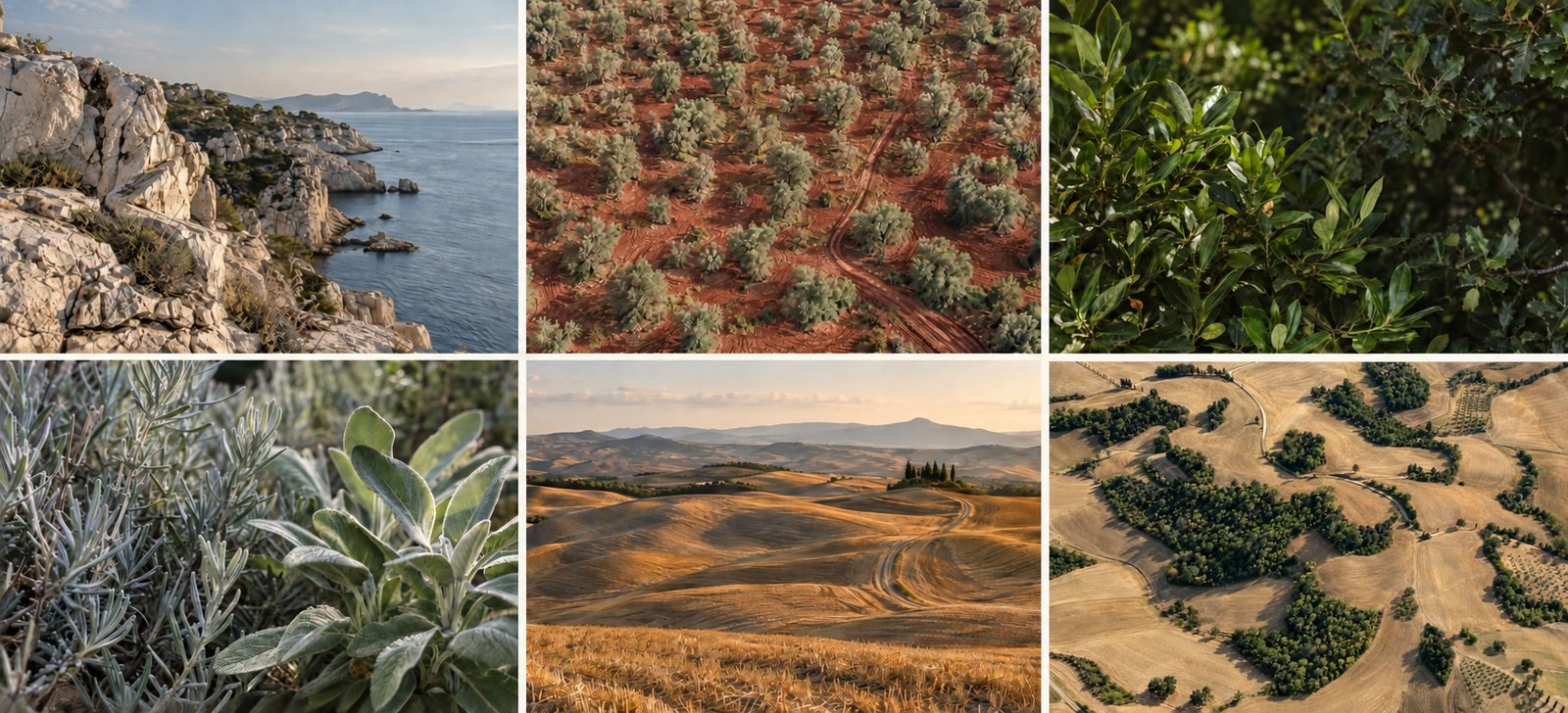
Natural Mediterranean landscapes support complex vegetation without daily irrigation, constant fertilising or regular clipping.
That does not mean nature is “maintenance-free”.
It means plants have developed relationships with local rainfall, soils, drought, wind and seasonal cycles.
This gives us an important design principle:
When Mediterranean plants with compatible ecological requirements are combined thoughtfully, we may reduce:
A low-maintenance garden therefore does not necessarily contain fewer plants.
Sometimes the opposite is true.
A well-structured plant community can live with its environment more easily than a uniform green surface that needs constant intervention to remain unchanged.
04|We do not need to invent every solution from scratch
Rethinking the Mediterranean garden today does not mean starting from zero.
Designers and plantspeople have been exploring the relationship between climate, vegetation and maintenance for decades.
At La Louve in Provence, Nicole de Vésian created a highly controlled planting landscape that remains closely connected to its local setting, using Mediterranean plants at different scales, with varied textures and grey-green tones.
Thomas Doxiadis, in his projects in Greece, instead seeks to extend the forms of the surrounding natural vegetation into the cultivated garden, allowing the boundary between the designed garden and the existing landscape to gradually become less distinct.
Olivier Filippi has spent many years studying drought-resistant plants and how thier perform under drought and foot traffic, developing a range of ground-cover strategies as alternatives to traditional lawn.
For me, these studies do not represent a “style” to be copied directly.
They are better understood as tools that help us rethink a few questions:
Where is lawn really necessary? Where can plants be used instead? Where is gravel more appropriate? And which areas can allow seasonal processes to unfold more naturally?
05|Water should be designed too, not distributed equally
Care also means rethinking how water is used.
A Mediterranean garden does not have to choose between “no irrigation” and “heavy irrigation everywhere”.
There are many possibilities in between.
If the owner loves lush summer planting, we can concentrate more intensive planting close to the house, terrace, entrance or areas used most frequently.
These can become small high-input oases, where greater investment in water and care makes sense because the area contributes directly to everyday life.
Further away, or in less frequently used parts of the garden, more drought-tolerant plant communities can be used, including species that naturally accept summer dormancy.
Water is no longer applied uniformly across the whole property.
Instead, it is allocated:
Reducing maintenance does not mean reducing quality of experience.
It means making clearer decisions about where resources matter most.
06|Low maintenance does not mean no maintenance
Every garden needs care.
Plants grow, compete, age and change.
Gardens evolve through seasons and years.
A low-maintenance garden is therefore not an abandoned garden.
It is a garden with a clear management logic.
From the design stage, we can decide:
Maintenance then stops being a series of unexpected problems.
It becomes part of the design strategy.
07|From garden design to a long-term care strategy
This is also why I consider future maintenance part of the design service.
For projects followed through implementation, we can develop a garden care and management strategy that may include:
The owner therefore receives more than a beautiful design.
They also receive a clear logic for keeping the garden healthy and coherent over time.
Care|A garden should serve your life, not the other way around
We can choose different planting and ground systems according to:
foot traffic · use · aesthetics · available time · maintenance budget · water availability
There is no universal correct ratio between lawn, ground covers, gravel, paving and naturalistic planting.
What matters is whether they respond to the way the garden will actually be lived in.
For me, Care is not about creating a garden that never needs attention.
It is about removing unnecessary maintenance and concentrating time, water and energy where they create real value.
Would you like to reduce the long-term maintenance of your garden without giving up richness, comfort and planting quality?